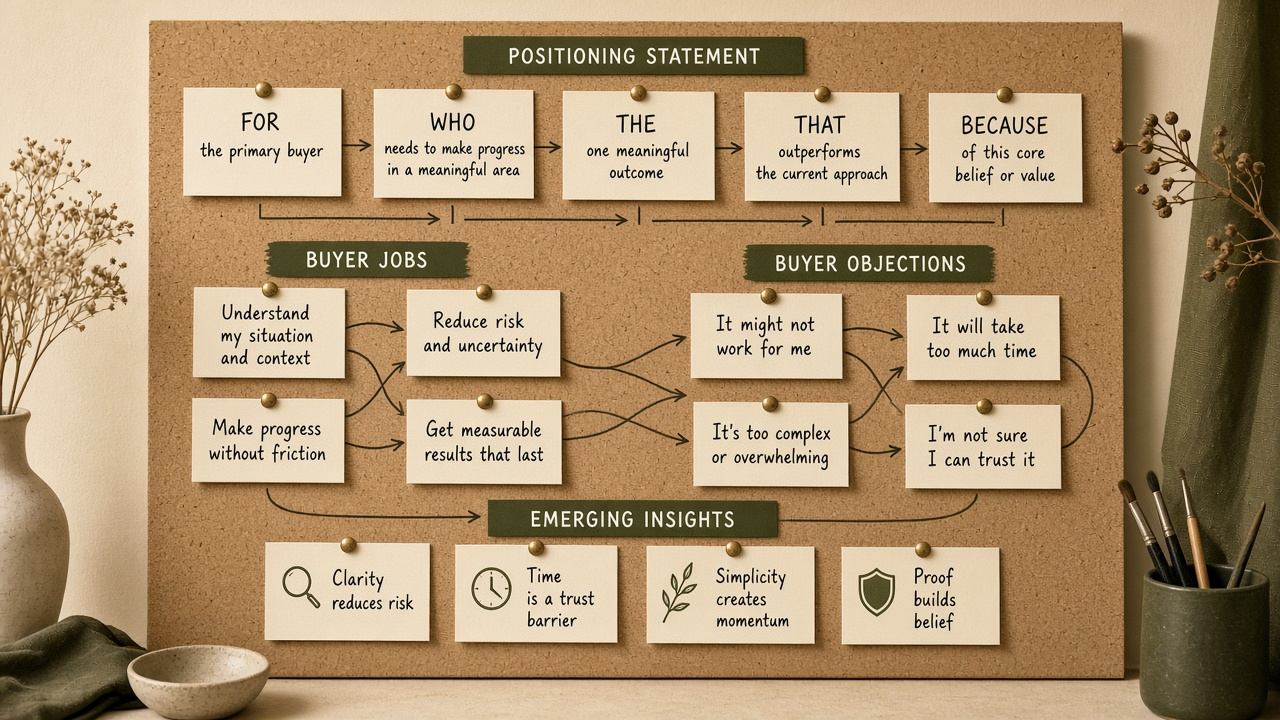
Build claims from jobs and constraints
Start with the job buyers hire your category to do, then list the constraints that make change expensive. Positioning that ignores constraints reads like advertising. Positioning that names constraints — dual entry risk, training windows, QuickBooks export anxiety — reads like research.
Write three draft statements: category frame, differentiated mechanism, and proof posture. The proof posture should describe the kind of evidence you have (repeated interview themes, observed contact-point stalls) and explicitly refuse representative-statistics cosplay when samples are small.
Pressure-test with decision roles
Read each draft aloud as if you were the economic buyer, the champion, and the blocker described in decision-maker research. If the blocker can dismiss it in one sentence, revise. If the champion cannot retell it without slides, simplify.
What nixbux refuses to claim
nixbux will not dress qualitative patterns as population statistics. We will not invent ROI guarantees from a dozen conversations. We will not ignore how U.S. operators talk about living beside QuickBooks when that language appears. Honesty is part of the brand of the research itself.
When synthesis is stable, feed it back into message tests and keep a living glossary — see the glossary — so product, sales, and marketing share definitions. For the full method stack, open research methods.